Monday, April 28, 2014

Choose your own Character: There Will be Tropes

Over Easter weekend I went with a friend to do some walks in Abel Tasman. We based ourselves in a backpackers hostel at Motueka and encountered, as you always will, some Characters.

The thing about Characters, especially when there's an edge of stereotype to them, is that they always have Stories. I've written up a few that we bumped into for you.

Tell me which ones you want to know more about, and I'll tell you their story. I can assure you, there will be tropes.


I didn't encounter any snow, or any naked hikers. But jeeze!They must be friggin' cold! Picture courtesy of  Xenophilia.


The Eccentric Backpacker Owner
Inevitably an expatriate (and, you suspect, an ex-patriot) of another nation, she has wild white hair that bursts in a storm of liberalism all over her head. She's lovely. She calls you "sweetheart" and "darling" in a strong American accent. She has strong opinions about many things and is able to find links between them that no one else can understand.

Enthusiastic Apple Immigrants
They're here to pick our apples, and they like New Zealand. They like the people, and the land, and the weather, and the orchards, and the many many more things. The only things wrong are the internet (third-world!) and the public transport (crap!).

Efficient German Walkers
They're tramping, and they're doing it efficiently. They have carefully selected their outfits and fitted their packs with the correct equipment and exact supplies required for their chosen course and for its duration (which has been estimated carefully for each segment). They walk in a straight line so that others might pass. Unfortunately, they walk in the middle of the path.

The Quiet Chinese Girl
She works at the hostel keeping to herself and the kitchen tidy. She smiles if she accidentally makes eye contact with you, and quietly wipes the kitchen bench. What mysteries does she harbour in her heart?

Business Suit in the Bush
He is a serious man. He always must wear a suit. Even he wears a suit when he is on holiday with his family. He wears the suit on the ferry taxi to the beach and for walking he wears the suit. (He does not speak English.)

The Bed-in-the-Van Man
True that he lives in his van, but he lives in it in style. He's got a new barbeque, and black velvet curtains to keep out prying eyes. He has a proper bed fitted, with a wooden frame and spring mattress and everything. He even has a dream catcher, all the way from California.

Bottom of the Cool Chain
In the group of cool kids, there's always one at the bottom. After all, to hone their bullying skills and make sure they keep their egos up it is essential that there is constantly someone they can torment around them. Sadly, this unfortunate soul doesn't realise it - mostly because he's a bit of a delusional try-hard jerk himself. Some might argue that, wearing that denim jacket with a shirt undone to the belly button, he's inviting it.

Backwards-Walking Voodoo Master
You're not quite sure if it actually was voodoo - in fact, you're sure it wasn't - but this strange creature was shuffling backwards around a Church on Easter Monday, early in the morning. You're not sure if it was male or female. You're not quite sure if it was human...

The "Not too bad, eh" Kiwi
"Aw, it wasn't too bad!" she says, to the great amusement of the Argentinians. She exalts the virtues of Marmite, and does so in a pair of navy-blue rugby shorts. She grew up on a farm with sheep on it, and has in fact fired a gun before.


Thursday, April 24, 2014

My Anzac

When I was little, every Anzac Day we'd go up our hill and slide down on bits of cardboard. It was always sunny, and it was always fun. Sometimes I fell off and rolled for a little way on the rocks and the sticks and the dry, slippery grass.


It was a family thing. Me and my brothers, and Mum and Dad, and sometimes my cousins too. It was on our land, our home - the hill with steep sides and huge rocks and the hard dirt track up to the top, eroded with water. The air had the minty smell of pennyroyal, and you could see everything, all the rolling farmland on each side of the river, and the mountains, and the ocean, and the sky.


For those of you who aren't familiar, ANZAC stands for Australia and New Zealand Army Corps. The first Anzac Day was 25th April, 1916, during the first World War. This marked one year after our soldiers had landed at Gallipoli for that disastrous campaign. Overall around 120,000 men died. Over 2,700 were New Zealanders.

This campaign, this war, this huge loss of life, changed the lives of many people. It changed New Zealand as well. We felt more united as a country, even though we were fighting in a war that shouldn't have happened on behalf of another country. We had been just another of England's colonies before, but after that we started to feel that we were our own nation.

Anzac was a way to remember the dead, and to honour those who had returned from service.  It was a way to stand together, to support each other, as a nation. And now, as other wars have come and gone and come, and as NZ takes part in all different ways, not just combat, Anzac is a place to remember them all.

2014 marks the centenary of the start of World War I.


My great grandfather fought in the war. He fought in the Gallipoli campaign, and was hit with a ball of shrapnel. They dug it out of his back on the beach and filled the wound with iodine  We still have the piece of shrapnel. It looks harmless. My grandpa had it, and gave it to my dad, and he gave it to my oldest brother when he got married last year.


Anzac Day matters to me because of this. I never knew my great grandfather, but the story of his life was such a big part of the lives of two of the most important men I've had in my life - my dad, and my grandpa.

I grew up with stories not about the war, but about my great grandparents, and the childhood that grandpa and my great aunt had. I grew up with stories of farms and shenanigans, and of love, and I grew up with those same things myself.


My grandpa wrote poems about the war, even though it ended before he was sent over. I was obsessed with English war poetry for about a year - Seigfried Sassoon, Wilfred Owen, but never Rupert Brooke (handsome though he may have been). I think about the farms our returned WWI soldiers worked on when they came back, the sheep station my grandpa worked on after his father died, all the land.

Alexander MacKenzie came back from the war, though he died younger than he should have. I never knew him. I didn't meet my great grandmother either. She died just before I was born, but they say when I was a baby I looked up, and in my eyes they saw her gaze.

For a lot of people, I know that Anzac Day is just a holiday. And for me, too, I suppose that it is. I've never been to a Dawn Ceremony. I don't like the word "honour" being used about war. I'm not a patriot. I'm not any kind of activist for any sort of movement.

Anzac Day for me is a piece of who I am. I always remember. I remember the people I love, and these stories we all built ourselves on.


What's Anzac Day to you?


Thursday, April 17, 2014

The bad weather trope

It's been raining for a week in Wellington. This is a great affront to people in my office. How dare the weather not be sunny? How dare the fog gather low on the ocean, or the mist drift out of the pines? How dare it rain?

The rain - this bad weather - has signaled a change in everyone's character. They are grumpy, or gloomy, or wretched, or wicked (someone used my mug, for example). We all well know that weather is empathetic. It reflects the mood or personality of characters. You know something bad's coming if the weather's bad.

If it's cloudy and a wind picks up, check that you're mood-meter isn't registering at "morose". If you're looking out over the ocean while you wait for your friend or family member to dock, there's bound to be some nefarious character aboard. Make sure to take an umbrella with you if you're going to a funeral. And if you're headed to battle, don't wear too much metal, just in case you attract the lightning.

For example. There's Wuthering Heights, with its dark brooding hero over the dark windswept (wiley windy) moors. And we've got our hard-boiled hard-drinking detective at eleven o'clock "with the sun not shining and a look of hard wet rain" in The Big Sleep. I can't help thinking of Highlander (you could put a full stop there, really) with the dramatic lightning storm as the Kurgen kills Rameriz. In Casablanca, it's raining when Rick gets Ilsa's letter saying that she cannot go with him or ever see him again. As Rick reads the letter (held conveniently still for long and for a reasonable length of time) we watch the water blur and wash away the ink of her sad message - as though it was his own tears.


It was the arrival of the Royals that set off the rain. They flew towards us, and the fog billowed up out of the ocean and covered the entire city. They came, and the bad weather came. Sure, they've left now, but what did they do while they were here? What will be uncovered in their wake?


My boss has used the bad weather trope to assign to me a moody, morose and melancholy aspect. I like mist in the pine forest too much. I have an unsettling appreciation of fog over the city. I don't mind walking in the rain. What dark things must go on in my mind?

On the contrary, I think it displays a positive aspect of my personality. I simply don't think the "bad weather" is as bad as everyone says. I've seen how important it is. I like being outside in it, and I like being inside out of it. 

I even don't get morose and melancholy when it delays my ferry by two hours. Three hours. I'll still get there, for a nice weekend of tramping in the ocean.


So, tell me, what do you think about "bad weather"? If someone's walking towards you and it suddenly thunders, do you cross the road (under the safety of an umbrella ? When you see lightning, do you reach for your sword?


It hurts?

Thursday, April 10, 2014

Characters who like hot jazz

If I'm going to talk about hipsters, I think it's appropriate that I give the original ones a mention.

The first hipsters were all about jazz.

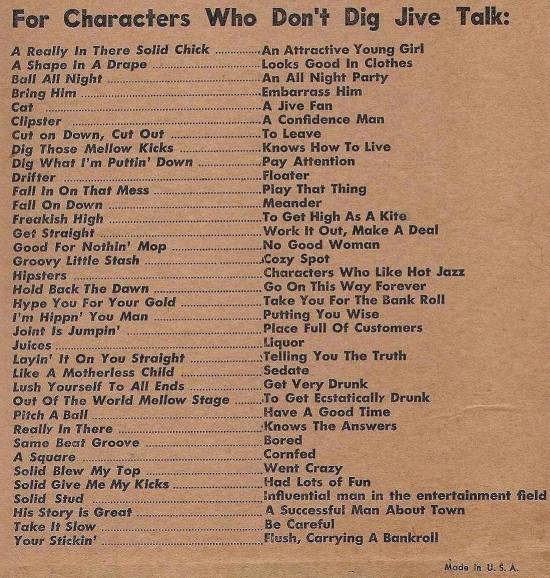
'For Characters who Don't Dig Jive Talk' - a glossary from the inside cover of Harry "the Hipster" Gibson's Boogie Woogie in Blue (image curtsey of hyzercreek)


It was the 40s. There was War going on in the whole world, for the second time. It ended in 1945. The men who came back had seen the world, and the women who'd stayed home had all been working jobs. The first real computers were being invented, and TV was still new. There were slinkies, and Tupperware, Fantasia, and high-waisted wide-legged long-coat zoot suits. There was racial division, and class division, and uncertainty.

At first, they called themselves "hepcats." "Hep" meant someone who was extremely knowledgeable about, and really rather fond of, jazz. It seems a jazz pianist - Harry "the Hipster" Gibson - is credited with the shift of hepcat to hipster, simply by inclusion in a short glossary that supplemented his 1944 album Boogie Woogie in Blue.*

Hipsters were Characters Who Like Hot Jazz.


1940s hipsters styled their lives around jazz culture. Jazz was changing. It was diverging from the path of popular music, becoming more exploratory and edgy, and sometimes becoming (I'll never take the name seriously) bebob. The image of the culture and music was increasingly alternative, converging with black culture, and certainly not for the higher classes. It - for hipsters - was dress, drugs, jargon, sarcasm, spontaneity, self-imposed destitution, and sex.

So was Harry "the Hipster" Gibson indeed The Hipster? The original? Who knows. ** He certainly knew hot jazz, and had the dancers to prove it.

They say his music was considered ahead of its time. Apparently his song "Who Put the Benzedrine in Mrs Murphy's Ovaltine" caused a bit of spleen in the jazz music scene. He did get out three more albums after his 1947 blacklisting - though, perhaps unsurprisingly, his album Harry the Hipster Digs Christmas wasn't a big hit. I'm glad he dug Christmas, though.


* I only ever boogie woogie in blue. Experience has shown me there is no other colour in which one can successfully boogie or woogie, let alone combine the two.
** Someone will.

Friday, April 4, 2014

The stories we tell ourselves

It occurred to me the other day that I may, possibly, be just a little bit of a hipster.

I was at a party wearing a floral dress paired with scuffed black boots. But it was the words I spoke, really. That night, I said “vintage,” “the collective” and “I liked them before they were popular.” I talked about beat poetry, even though I hardly know a thing about it, and espoused the value of locally-sourced organic food even though I’d had a Double Bacon Burger for dinner. But it got worse.

“I don’t like this music,” I said. “It’s too mainstream for me.”

The fact that I’d said the word was bad enough, but that I’d emphasised it? And I had a bottle of craft beer in my hand. I really don’t know how it got there. I hate beer.

I was alarmed. I don’t want to belong to a sub-culture. I’m above being labelled. You can’t just shove me in a box because I diverge from the conventions society thrusts upon us. I don’t conform to anything or anyone. I value independent thinking, and shun the latest trends and fashions. I’m creative and progressive, unconventional, different.

Shit.

scuffed boots and florals

I live in Wellington. I’ve lived here for six years now, before it was cool. It’s a great city. From my new flat I can see the harbour, Somes Island in the middle, and the eastern hills behind them layered on top of each other. I keep meaning to go out to their southern-most tip, where the white Pencarrow lighthouse watches the strait between the two islands, but somehow I just keep on not doing it. I will.

The best time of year has just begun. It’s Autumn, so things are cooler at last but the sun is still warm. It’s easier to sleep. The plants are settling down from the flurry of summer, and people are relaxing. Daylight saving ends this weekend. It's been dark when I wake, but on Monday when my second alarm goes off at 7.01 I'll see the first sunlight glowing on the clouds that are almost always sitting above those hills across the harbour.

Because I like stories and thinking about myself, sometimes I try to imagine what kind of novel or sitcom or fantasty-slasher (if that’s not a real thing, then by god it’s going to be by the time I’m done) I would belong in. I try to work out the character I would play.

It’s possible – I have an Arts degree, an appreciation of the alternative, a certain smugness –  I’d be the hipster.

But I'm not all hipster, and why stop there? I’d like to be just a little bit of everything, and some days a lot of it. I could just as easily be cast as the goth, or the emo, the hippie, the yuppie, the manic pixie dream girl. I’d like to try them all. I’d like to wake up and every morning dress my life in whatever genre I choose, and be whichever of the characters is most fitting at the time.

This is a blog about tropes, and being alive.

It’s a common misconception that tropes are a sweet, sticky fruit that grew on mythological vines in ancient Mesopotamia. They are in fact themes and devices and conceptual figures of speech that we use to build stories. They’re stereotypes, and plot devices, and subjects and symbols and formulas and clichés.

Tropes are the patterns and conventions that help us understand what something is about, and help us anticipate what might happen. They help us work out what it all means.


And that’s it really, for me. I think we’re just the stories we tell ourselves about who we are.